PURSUE 档案馆 / 太空任务遭遇 / Apollo 17·通话录(1972)
Apollo 17·通话录(1972)
Apollo 17 Transcript (1972)
1972年,NASA阿波罗17任务通话记录中,宇航员观察到不明碎片。
In 1972, during the Apollo 17 mission, astronauts observed unknown fragments.
摘要 Summary
在1972年NASA的阿波罗17任务中,宇航员在执行太空船机动时,通过窗口观察到一些非常明亮且形状不规则的碎片。这些碎片似乎在缓慢旋转,并且没有相对运动。宇航员尝试通过相机捕捉这些碎片,但无法确定它们的来源或性质。
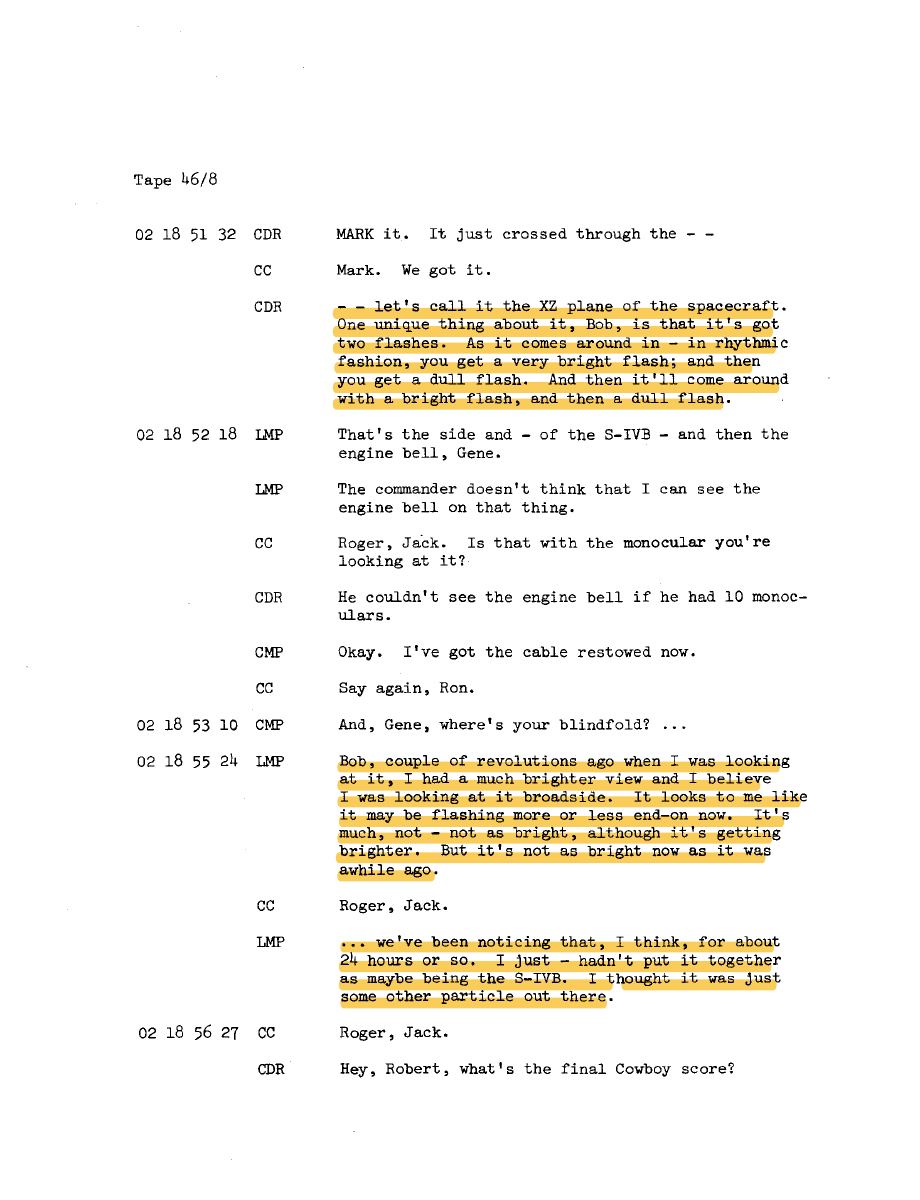
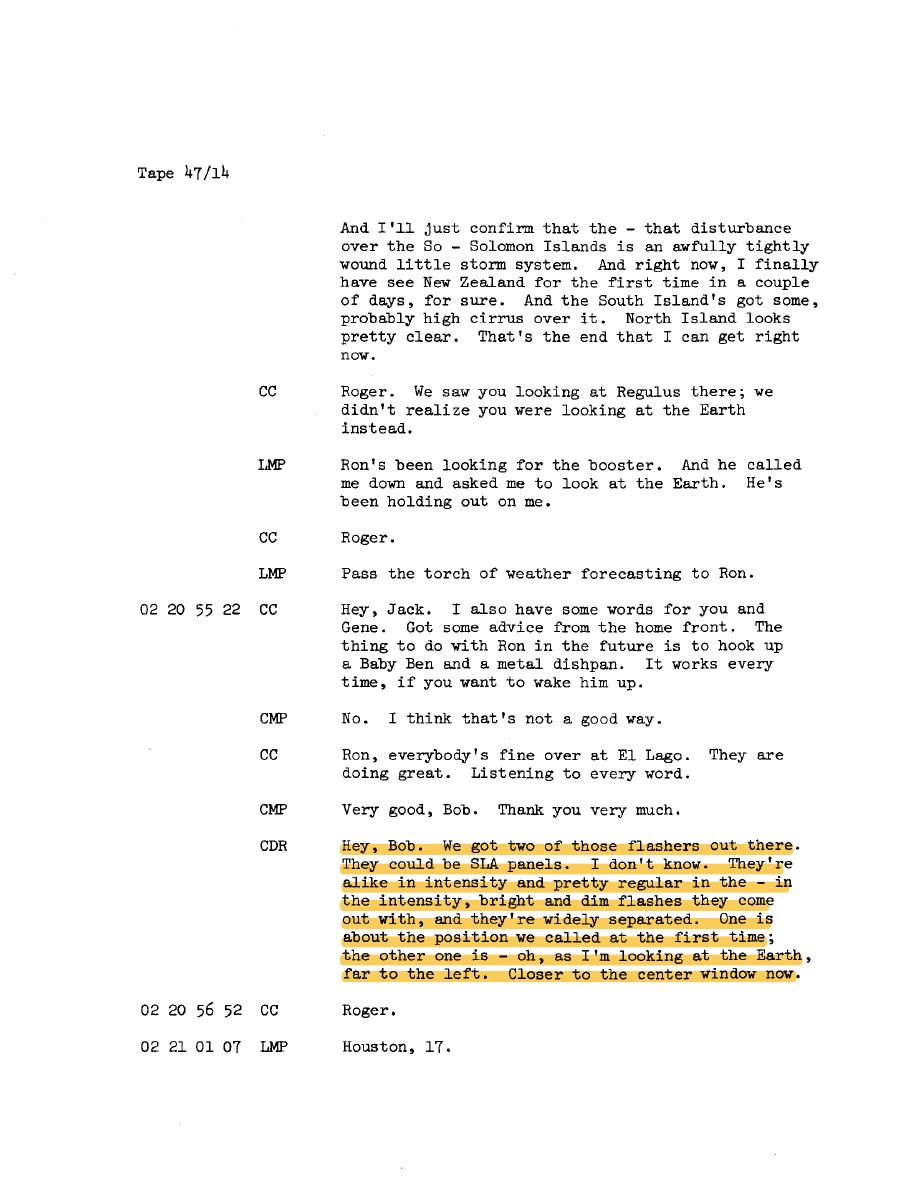
During the 1972 NASA Apollo 17 mission, astronauts observed very bright, irregularly shaped fragments while performing spacecraft maneuvers. These fragments appeared to be tumbling slowly and had no apparent relative motion. The astronauts attempted to photograph the fragments but were unable to determine their origin or nature.
原档图像 Embedded Pages · 12 extracted
从 PDF 内提取,最多 12 张代表性页面/影像。完整内容请下载原档。
关键段落对照 Bilingual Excerpts
EXCERPT · 01
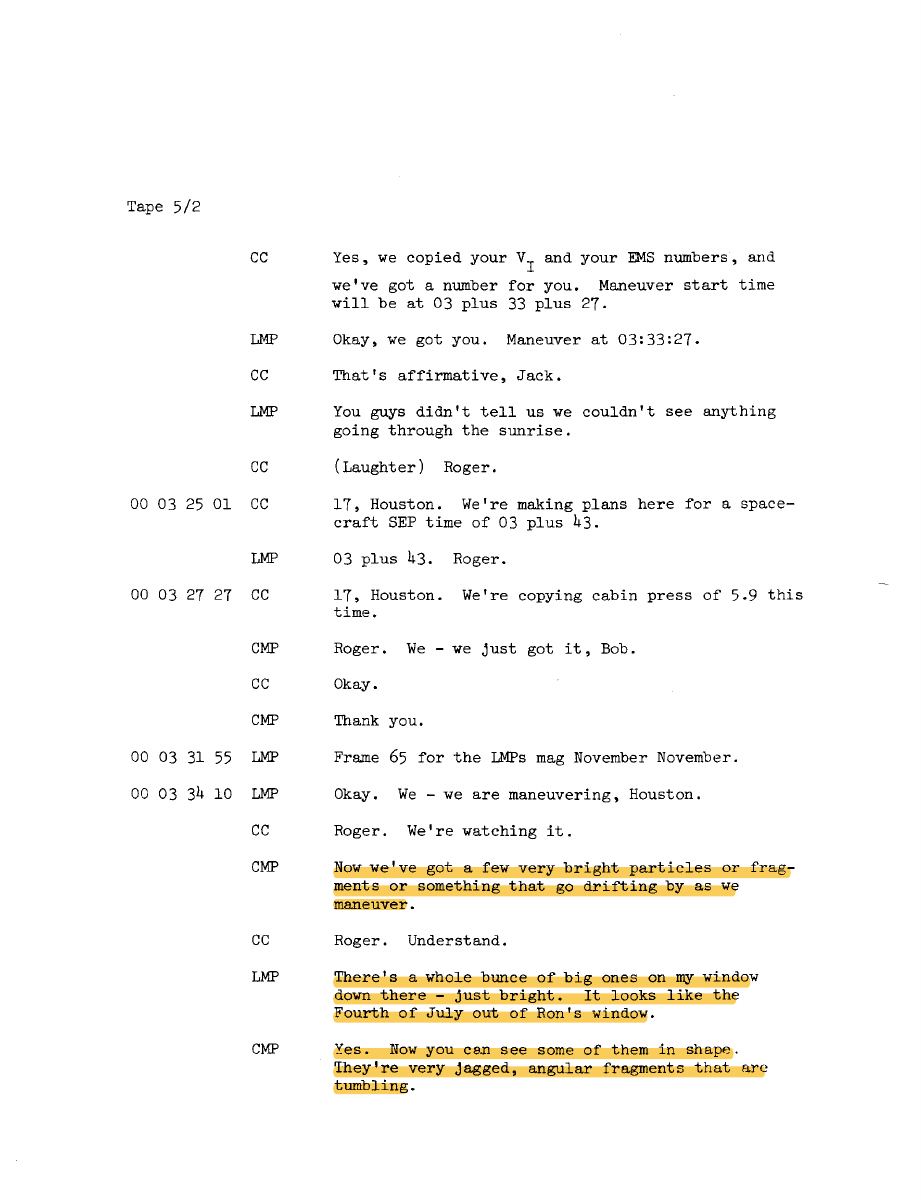
Tape 5/2
译文 · 01
录音带5/2
EXCERPT · 02
03 plus 33 plus 27
译文 · 02
03:33:27
EXCERPT · 03
Maneuver start time will be at 03 plus 33 plus 27
译文 · 03
机动开始时间为03:33:27
EXCERPT · 04
Frame 65 for the LMPs mag November November
译文 · 04
LMPs磁力计的帧65号
EXCERPT · 05
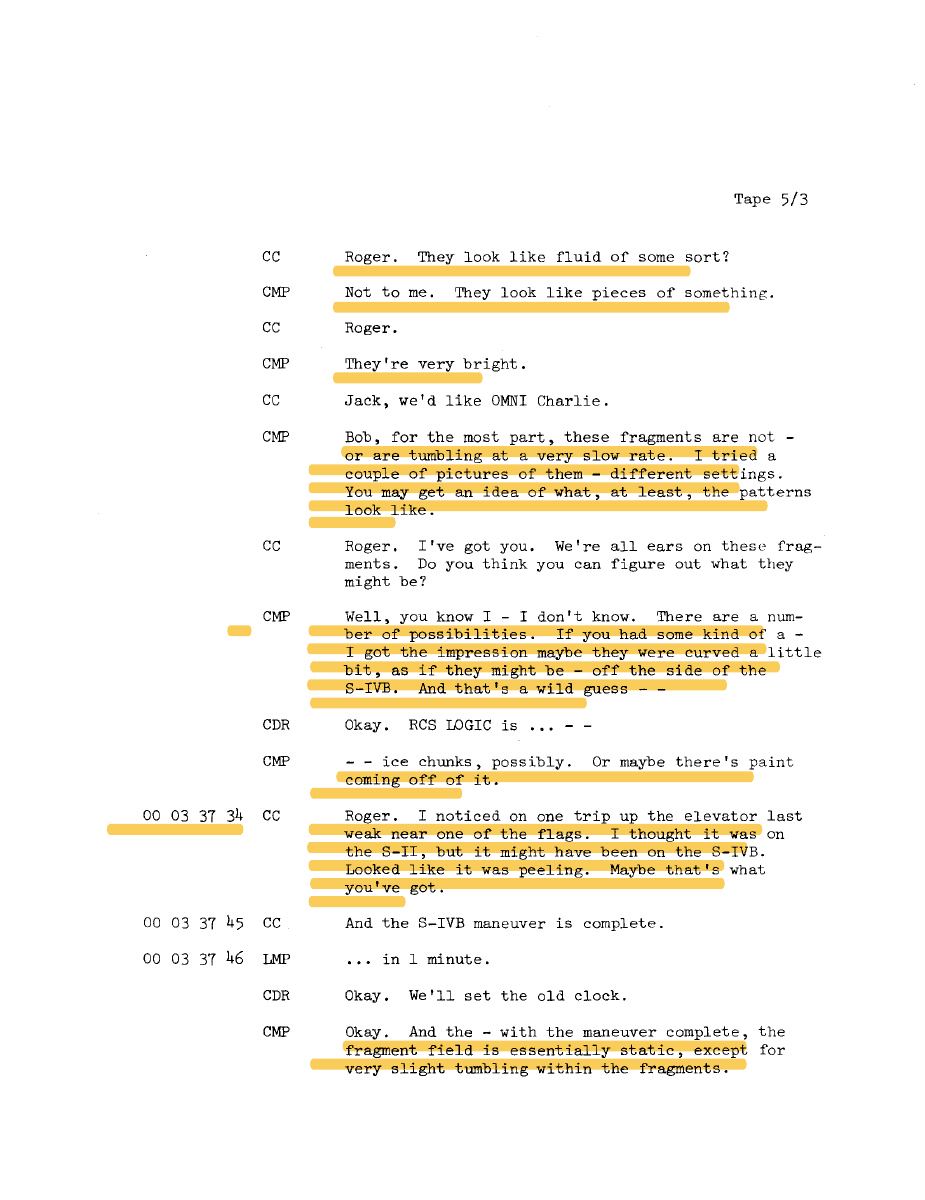
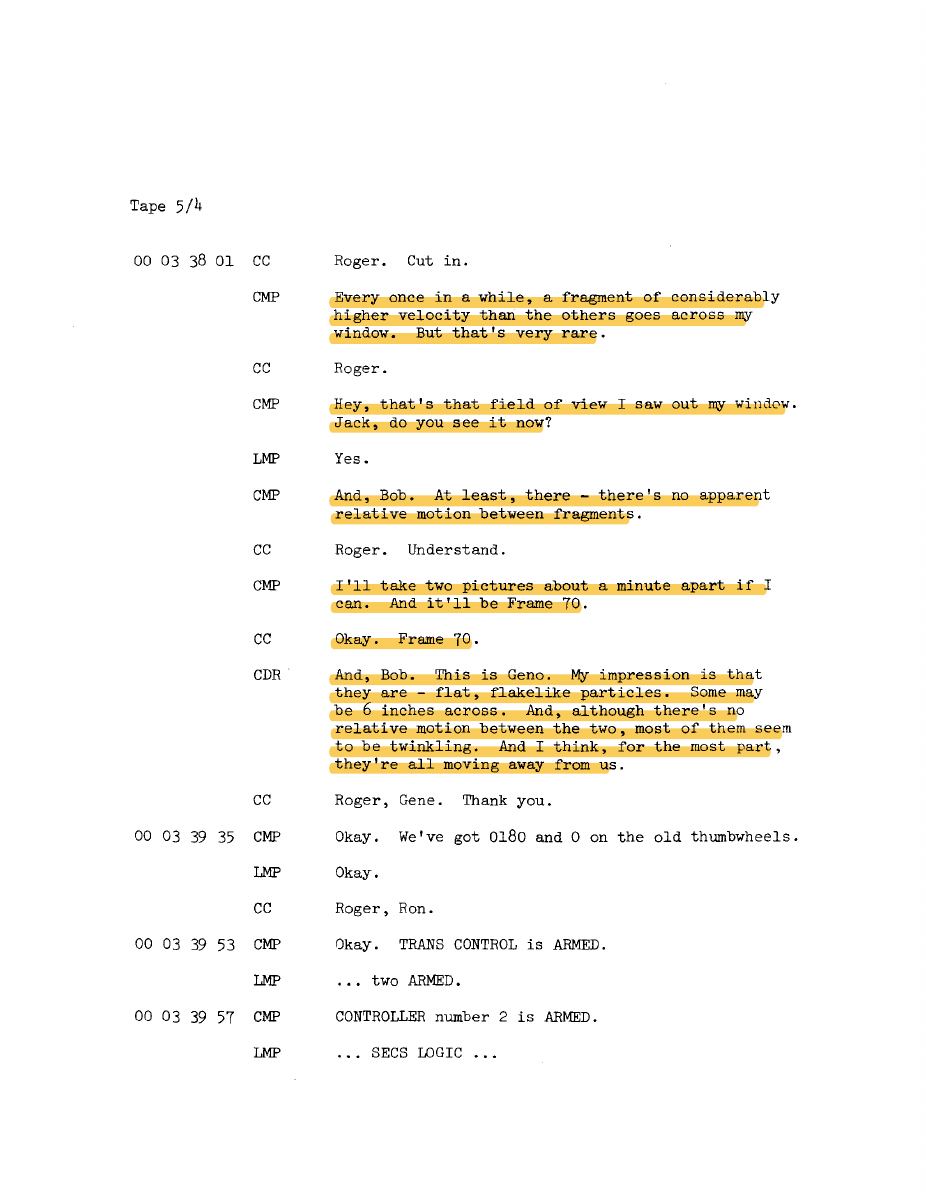
They're very jagged, angular fragments that arc tumbling
译文 · 05
它们是非常尖锐、角度的碎片,呈弧形滚动
EXCERPT · 06
ice chunks, possibly. Or maybe there's paint coming off of it
译文 · 06
可能是冰块。或者可能是油漆正在剥落
标签 Tags
展开原文抽取(pdftotext,未翻译) · Show extracted source
Tape 5/2 CC Yes, we copied your VI and your EMS numbers, and we've got a number for you. Maneuver start time will be at 03 plus 33 plus 27. LMP Okay, we got you. Maneuver at 03:33:27. cc That's affirmative, Jack. LMP You guys didn't tell us we couldn't see anything going through the sunrise. cc (Laughter) Roger. 00 03 25 01 cc 17, Houston. We're making plans here for a space craft SEP time of 03 plus 43. LMP 03 plus 43. Roger. 00 03 27 27 cc 17, Houston. We're copying cabin press of 5.9 this time. CMP Roger. We - we just got it, Bob. cc Okay. CMP Thank you. 00 03 31 55 LMP Frame 65 for the LMPs mag November November. 00 03 34 10 LMP Okay. We - we are maneuvering, Houston. cc Roger. We're watching it. CMP Now we've got a few very bright particles or frag ments or something that go drifting by as we maneuver. CC Roger. Understand. LMP There's a whole bunce of big ones on my window down there - just bright. It looks like the Fourth of July out of Ron's window. CMP Yes. Now you can see some of them in shape. 'They're very jagged, angular fragments that are tumbling. Tape 5/3 CC Roger. They look like fluid of some sort? CMP Not to me. They look like pieces of something. CC Roger. CMP They're very bright. CC Jack, we'd like OMNI Charlie. CMP Bob, for the most part, these fragments are not - or are tumbling at a very slow rate. I tried a couple of pictures of them - different settings. You may get an idea of what, at least, the patterns look like. CC Roger. I've got you. We're all ears on these frag ments. Do you think you can figure out what they might be? CMP Well, you know I - I don't know. There are a num ber of possibilities. If you had some kind of a - I got the impression maybe they were curved a little bit, as if they might be - off the side of the S-IVB. And that's a wild guess CDR Okay. RCS LOGIC is ... - - CMP - - ice chunks, possibly. Or maybe there's paint coming off of it. 00 03 37 34 cc Roger. I noticed on one trip up the elevator last weak near one of the flags. I thought it was on the S-II, but it might have been on the S-IVB. Looked like it was peeling. Maybe that's what you've got. 00 03 37 45 cc And the S-IVB maneuver is complete. 00 03 37 46 LMP in 1 minute. CDR Okay. We'll set the old clock. CMP Okay. And the - with the maneuver complete, the fragment field is essentially static, except for very slight tumbling within the fragments. Tape 5/4 00 03 38 01 cc Roger. Cut in. CMP Every once in a while, a fragment of considerably higher velocity than the others goes across my window. But that's very rare. CC Roger. CMP Hey, that's that field of view I saw out my window. Jack, do you see it now? LMP Yes. CMP And, Bob. At least, there - there's no apparent relative motion between fragments. CC Roger. Understand. CMP I'll take two pictures about a minute apart if I can. And it'll be Frame 70. CC Okay. Frame 70. CDR And, Bob. This is Geno. My impression is that they are - flat, flakelike particles. Some may be 6 inches across. And, although there's no relative motion between the two, most of them seem to be twinkling. And I think, for the most part, they're all moving away from us. cc Roger, Gene. Thank you. 00 03 39 35 CMP Okay. We've got 0180 and 0 on the old thumbwheels. LMP Okay. cc Roger, Ron. 00 03 39 53 CMP Okay. TRANS CONTROL is ARMED . LMP . . . two ARMED. 00 03 39 57 CMP CONTROLLER number 2 is ARMED . LMP ... SECS LOGIC ... Tape 5/5 00 03 40 01 CMP Okay. SECS LOGIC is CLOSED; SECS ARM are CLOSED; LOGIC POWER is ON. LMP Okay. 00 03 40 13 cc 17, Houston. You have a GO for T&D. CDR Okay. A GO for T&D. 00 03 40 38 CMP Okay. We'll ARM the PYROs. And we'll hit the GDC ALIGN. 00 03 41 00 CMP And maneuver's complete. And 0180 and O? On the GDC? No. It's just ... It's kind of diddling. 00 03 41 19 CMP Okay. DELTA-Vin NORMAL. 00 03 41 42 CMP S-IVB, okay. Okay, switches are all set. LMP Okay; 59 : 30 . 00 03 41 55 CMP Okay. Let's start the DET. 00 03 41 59 CDR Tickity-tick-tickity, Houston. We're running at 59: 30. cc Roger. CMP Okay. 00 03 42 12 CMP Okay. That's LAUNCH VEHICLE SEP, push button. LMP Okay. 00 03 42 19 CMP MC in AUTO. CMP Next? 00 03 42 29 CDR SEPARATION, Houston. CMP Okay, check the covers. Okay. And check the other ones off. LMP They're all ... CMP Okay, I'm going to start the - My gr.,sh, look at the junk! Okay; there's 15 seconds. Pitch her up. Okay, we'll PROCEED on the - - Tape 46/4 02 18 4111 CDR Okay. Is that it? Yes, I can get that, Gene. CMP Okay, you want to take a picture of it first? Okay, POWER ... Okay, stand by. 3, 2, 1 - 02 18 41 59 CMP MARK it. POWER switch OFF. CDR Say, Bob or Stu. cc Roger. Go ahead. 02 18 42 34 CDR Okay, add - to ad to today. Not last night, but - I guess the first night I was in bed - I definitely saw some of these - because I had a hard time going to bed, to start with - I saw some of the same peripheral horizon-type things you said were not the type of data you were looking for; but I also saw a - some sets of the streaks. And probably the one most imposing thing I remember is - and the last one I remember before falling asleep - was the fact that there was a very bright spot that flashed right between my eyes like a very bright headlight - like a train coming at you, only with a flash. It's difficult probably to estimate the frequency of any of those because I was in a - sort of a sleep-hazy mode. CC Roger. CDR But then, as today, I saw some that flashed and lit up the horizon and some that lit up peripher ally; and I guess, as you say, that's a different kind of data, but I did see them there and they impressed me. CC Okay. We got all that, Gene. CDR Okay. CMP And it might be interesting to know I've never seen it before today. CC Hey, Gene, we appreciate all the data. We were just trying to make the data fit the curve; you know the old trick. Tape 46/5 02 l8 44 40 CDR Okay, I just wanted you to - just told them like we saw them. That's all. CC Roger. CDR I will say one thing, though; no question in my mind but that they're there. Last trip I took, I guess I just wasn't looking for them or paying any attention to them. Maybe they were there and I ignored them because of other things. But they're there. LMP Okay, all you flash bugs down there - or flash bulbs I guess is the word - frame 50. I just took four pictures to show - two on the side and two on the bottom - to show the position of the ALFMED, and one of them of each set was focused on the ALFMED. The others were focused on the - the other set was focused on the struts. CC Roger, Jack. LMP And when you don't have anything else to do, why don't you have somebody predict where the S-IVB is. I think I've got her spotted - behind us and above us with respect to the Earth and our travel from it. CC FIDO just went out and shot himself, but we'll get working on it. LMP Oh, don't worry about it. Shoot. I thought you guys might have an idea off-the-cuff there. CC No, what's humorous on this, Jack, is they have really been working on that S-IVB impact point - and they've really been - it's been a - a real difficult problem for them so far. LMP I'll tell you, I bet you Ron could give a star sighting on it (laughter). I looked at it through the monocular and sure looks like the S-IVB. CC Jack, we're not doubting you at all. We could probably start cranking it right now. Tape 46/6 02 18 46 46 cc Jack, are you sto - you all stowing the ALFMED now or are you done? CMP What's that, Bob? CC Are you all done with the ALFMED now, Ron? CMP Yes, I've got to get it to - get the plate moved back down there yet. CC Okay, Ron - CMP get the blindfold off first so I can see what I'm doing. CC Roger. I just want you to know. We've got a real long update coming up to you here on the LOI abort charts and that - and it's going to be, probably, a difficult readup. And you're the most familiar with the charts; you probably would want to take them. But whenever you want to take them, they are on - charts on page 3-81, 3-82, and then the cue card for LOI limits. Whenever you want to take them. It will be a lengthy one. CMP Stand by, Bob. Let us get squared away from the ALFMED; then we can get going on that. CC No, I don't want to hurry you, Ron. I just want you to know what - when - just get yourself com fortable and be ready to take them whenever you want them. It's going to be a lengthy time, though. 02 18 47 51 CMP Okay. CDR Hey, Bob, I'm looking at what - what Jack was talking about; and it's definitely not a particle that's nearby because there is another one I can look at and get a three-dimensional comparison with. It is a - it is a bright object, and it's obviously rotating because it's flashing. It's way out in the distance, as I say, because there are particles that are close by and it's obviously not one of those. It's apparently rotating in a Tape 46/7 very rhythmic fashion because the flashes come around almost - almost on time. And it's as we look back at the Earth, it's up at about 11:00 about - oh, maybe 10 or 12 Earth diameters. I don't know whether that does you any good, but there is something out there. CC Roger. We don't doubt it, Gene. And we might work out a set of gimbal angles or something here; maybe we can get a look at it through the optics. 02 18 49 02 CDR Okay. And I - I I just want to emphasize that it's definitely not - not one of these particles that tends to look like a star out there. It's something physical in the distance. (Laughter) Oh, yes. SC thing off. 02 18 50 13 CMP Yes, guess I am. CC Okay, Gene. If you can call up a NOUN 20 so we know the spacecraft attitude, and if you can reference the object you're looking at out of your window, with - with respect to body axis and let us look at your - your - give us a mark, somehow, and give us your NOUN 20s, we can try and get a tie-in and start locating - locating this object down for you. 02 18 50 58 CDR Okay, I'm looking it out - looking at it out the center window - the hatch window - and I'll give you a hack when it crosses the XX axis at the center window; and I guess it's up maybe 45 degrees. CC Okay, give us a hack and we're copying your NOUN 20s right now. CDR Okay, Jack says pitched up about 30 degrees but - - LMP No. 45, because - CDR Yes, he agrees. It's 45 degrees pitched up, and I'll give you a hack when it crosses the XX axis. CDR Okay - Tape 46/8 02 18 51 32 CDR MARK it. It just crossed through the - - CC Mark. We got it. CDR let's call it the XZ plane of the spacecraft. One unique thing about it, Bob, is that it's got two flashes. As it comes around in - in rhythmic fashion, you get a very bright flash; and then you get a dull flash. And then it'll come around with a bright flash, and then a dull flash. 02 18 52 18 LMP That's the side and - of the S-IVB - and then the engine bell, Gene. LMP The commander doesn't think that I can see the engine bell on that thing. cc Roger, Ja.ck. Is that with the monocular you're looking at it? CDR He couldn't see the engine bell if he had 10 monoc ulars. CMP Okay. I've got the cable restowed now. cc Say again, Ron. 02 18 53 10 CMP And, Gene, where's your blindfold? ... 02 18 55 24 LMP Bob, couple of revolutions ago when I was looking at it, I had a much brighter view and I believe I was looking at it broadside. It looks to me like it may be flashing more or less end-on now. It's much, not - not as bright, although it's getting brighter. But it's not as bright now as it was awhile ago. CC Roger, Jack. LMP ... we've been noticing that, I think, for about 24 hours or so. I just - hadn't put it together as maybe being the S-IVB. I thought it was just some other particle out there. 02 18 56 27 cc Roger, Jack. CDR Hey, Robert, what's the final Cowboy score? Tape 46/9 CC Okay; I was just going to update that. The Cowboys won it 34 to 24. And by winning it, they wrap up the wild-card slot in the NFC; and so both Wash ington and Dallas will be in the playoffs. 02 18 56 53 CDR Sounds good. LMP Bob, that line of clouds I called a fir-tree pat tern that swings up towards Hawaii: Hawaii, if you will - has - also has a mushroom pattern on the top. It has the appearance as if tvo major air masses - one going from west to east and the other form east to west - have converged along that line, and the joint movement of air at the interface being south to north. And up in the area of Hawaii, I think, it tends to mushroom so that the pattern then goes back to flow from west to east on the east side and from east to west on the west side. CC Roger. 02 18 58 27 LMP In a little while, we'll probably get a pretty good look at a - what looks like a very concen trated intense storm that, I think, is just - east - CMP *** And then we' 11 put them. once we get updated a little bit. Yes, I'll get out of VOX in a minute. LMP I was looking for the Flight Plan and stuff. And the little books. LMP Say, Bob. CC Go ahead. LMP Houston, 17. How do you read? CC Go ahead, Jack. Read you loud and clear. CDR Okay, Bob, you want to update the LOI card and Flight Plan 3-82 and 3-81; is that right? CC That's affirmative. CDR Which one do you want to start on? Tape 47/14 And I'll just confirm that the - that disturbance over the So - Solomon Islands is an awfully tightly wound little storm system. And right now, I finally have see New Zealand for the first time in a couple of days, for sure. And the South Island's got some, probably high cirrus over it. North Island looks pretty clear. That's the end that I can get right now. CC Roger. We saw you looking at Regulus there; we didn't realize you were looking at the Earth instead. LMP Ron's been looking for the booster. And he called me down and asked me to look at the Earth. He's been holding out on me. CC Roger. LMP Pass the torch of weather forecasting to Ron. 02 20 55 22 cc Hey, Jack. I also have some words for you and Gene. Got some advice from the home front. The thing to do with Ron in the future is to hook up a Baby Ben and a metal dishpan. It works every time, if you want to wake him up. CMP No. I think that's not a good way. CC Ron, everybody I s fine over at El Lago. They are doing great. Listening to every word. CMP Very good, Bob. Thank you very much. CDR Hey, Bob. We got two of those flashers out there. They could be SLA panels. I don't know. They're alike in intensity and pretty regular in the - in the intensity, bright and dim flashes they come out with, and they're widely separated. One is about the position we called at the first time; the other one is - oh, as I'm looking at the Earth, far to the left. Closer to the center window now. 02 20 56 52 cc Roger. 02 21 01 07 LMP Houston, 17, Tape 47/15 CC Go ahead. LMP Yes, Bob, what is your - analysis chart, if you have it - surface tenns analysis chart show for Hawaii today? CC Stand by on that. CC Jack, according to the - - LMP The reason I ask is that for using your term - Go ahead. CC No, go ahead on that, Jack. LMP I was going to say, using your terminator time as a partial - mark for where Hawaii ought to be, Hawaii ought to be, it looks like that cyclonic circulation at the north end of the cloud bank I described, approaching that area, would be Just about on the Hawa - Hawaiian Islands. I'm curious if they're getting some weather down there now. CC Stand by right now; I've got my weathennan right beside me here. LMP Also, that major front we talked about last night as being east and south of Japan has progressed even farther and is, oh, maybe 20 degrees longi tude - about 20 degrees longitude from the Hawaiian Islands. And I'm making some guesses on exactly where Hawaii is. CC Roger, Jack. We've got nothing adverse in the Hawaiian area at all. Just a lot of winds , high winds and surface winds and surface roughness, but we don't have any bad cloud area in the Hawaiian area. I'll get the Hickam sequence re port here shortly, Jack. LMP Okay, ... a little bit. The - our zero-phase point is now centered just a little south of the disturbance near the Solomon Islands. And I see no distinct change in the intensity of that zero phase point over what I had talked about a couple hours ago.